
Free up space
Find and Delete Duplicate Photos on a Mac
The MacZentra team · Updated Nov 10, 2026 · 8 min read
Photos rarely duplicate as exact copies. You export the same shot twice at different sizes, an app re-encodes it on upload, or a file comes back as photo (1).jpg. This guide covers all three routes to a clean library: the free Duplicates album in Photos, the folders Photos never sees, and the near-duplicates that only image matching can catch. It matters most on a 256 GB MacBook Air, but the steps work on any Mac.
Two kinds of "duplicate" photo
| Kind | Example | How to catch it |
|---|---|---|
| Exact copy | The same file saved in two folders | Content hash (same as any file). See the general duplicates guide. |
| Visual near-duplicate | A resized or re-encoded version of the same picture | Perceptual hashing (fingerprints the image). |
| Renamed copy | “report.jpg” vs “report copy.jpg” | Fuzzy filename matching. |
For exact copies of any file type, see finding duplicate files. The rest of this guide is about photos.
Start with the Duplicates album in Photos
Since macOS Ventura, the Photos app can group duplicates for you. Open Photos, scroll the sidebar to Utilities and click Duplicates. The album only appears once Photos has found something, so if you don't see it, either you're clean or the first scan is still running. On a big library that first pass can take hours, so leave the Mac plugged in overnight.
Pick a set and choose Merge. Photos keeps the best version, carries over the metadata and sends the extra copies to Recently Deleted. They stay there for 30 days, which means you won't get the space back until you open that album and choose Delete All.
Apple doesn't publish how strict the matching is. People who've used it report that it catches more than byte-for-byte clones, such as a full-size photo sitting next to a smaller copy of itself. It's a solid first step, but it only looks inside the Photos library.
Check the folders Photos never sees
Photos can't flag a picture it doesn't manage. Email attachments pile up in Downloads, AirDropped shots land on the Desktop, and old project folders keep their own copies. A Finder Smart Folder pulls all of them into one list:
- In Finder, choose File, then New Smart Folder.
- Click the + button at the top right of the window.
- Set the first menu to Kind and the second to Image.
- Sort by Name. Files like IMG_2041 (1).jpg or IMG_2041 copy.jpg will sit right next to the original.
Compare the size and date of each pair before you trash anything. Two files with the same name aren't always the same picture.
Catch the near-duplicates
This is the part most people miss. Resize a photo for an email, re-export it from an editor or let a messaging app recompress it, and you have a new file that looks identical but isn't. Exact-match tools skip it. Finding these takes matching that understands the image, not just the bytes.
How perceptual matching works
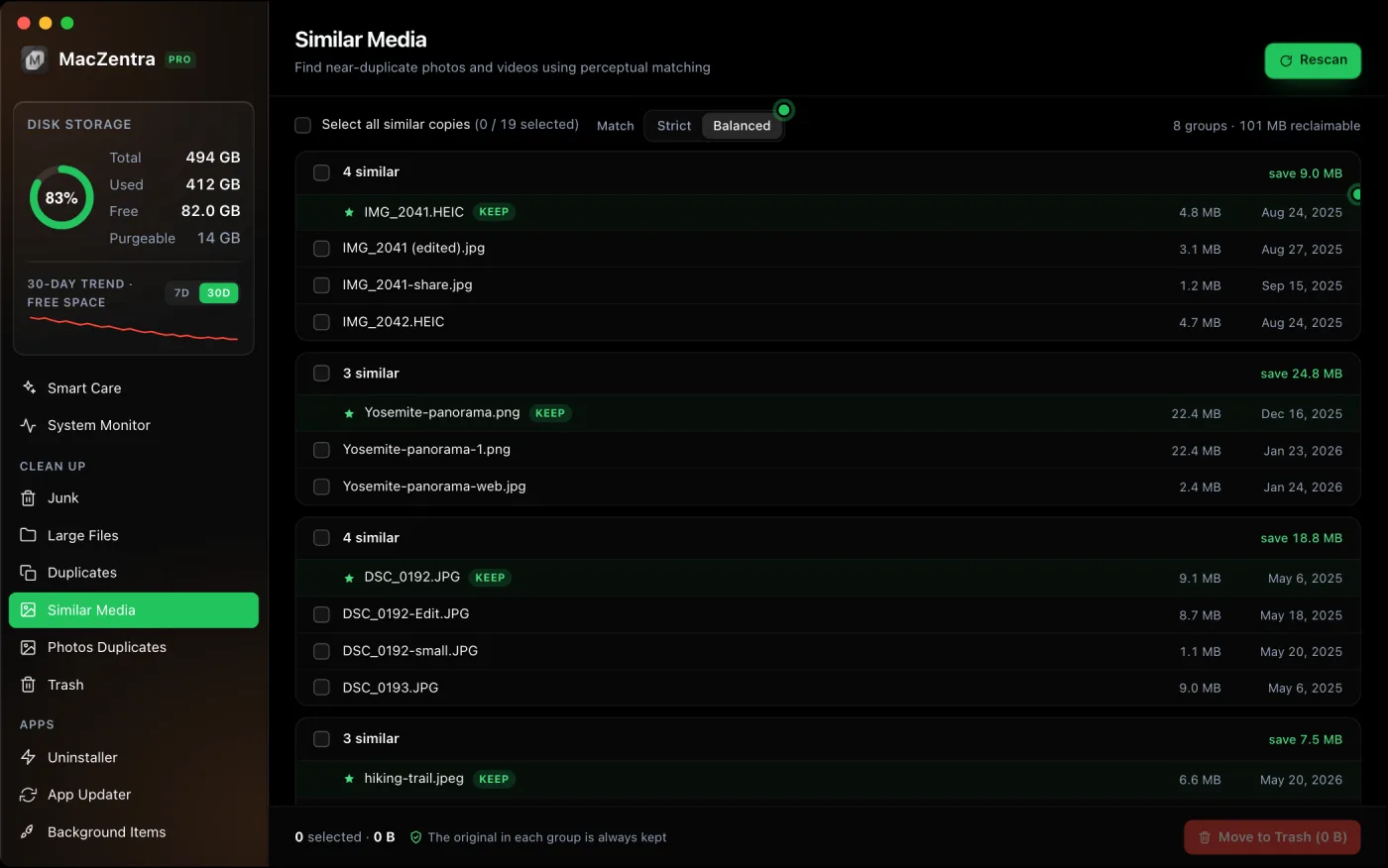
Instead of hashing bytes, perceptual matching shrinks each image to a tiny grayscale version and derives a short fingerprint from it. Two images that look alike produce near-identical fingerprints even at different sizes or compression levels. The quality of the result depends entirely on how the fingerprint is built, and on refusing to group images unless several independent signals agree.
Why not just trust the match and delete?
Because "looks the same" isn't "is the same". A near-duplicate might be the higher-resolution original you want to keep, or a deliberately edited version. Good tooling shows a similarity percentage and never pre-selects fuzzy matches for deletion, you confirm each one. Keep the best copy (usually the largest file, or the untouched original) and remove the rest.
Where MacZentra fits
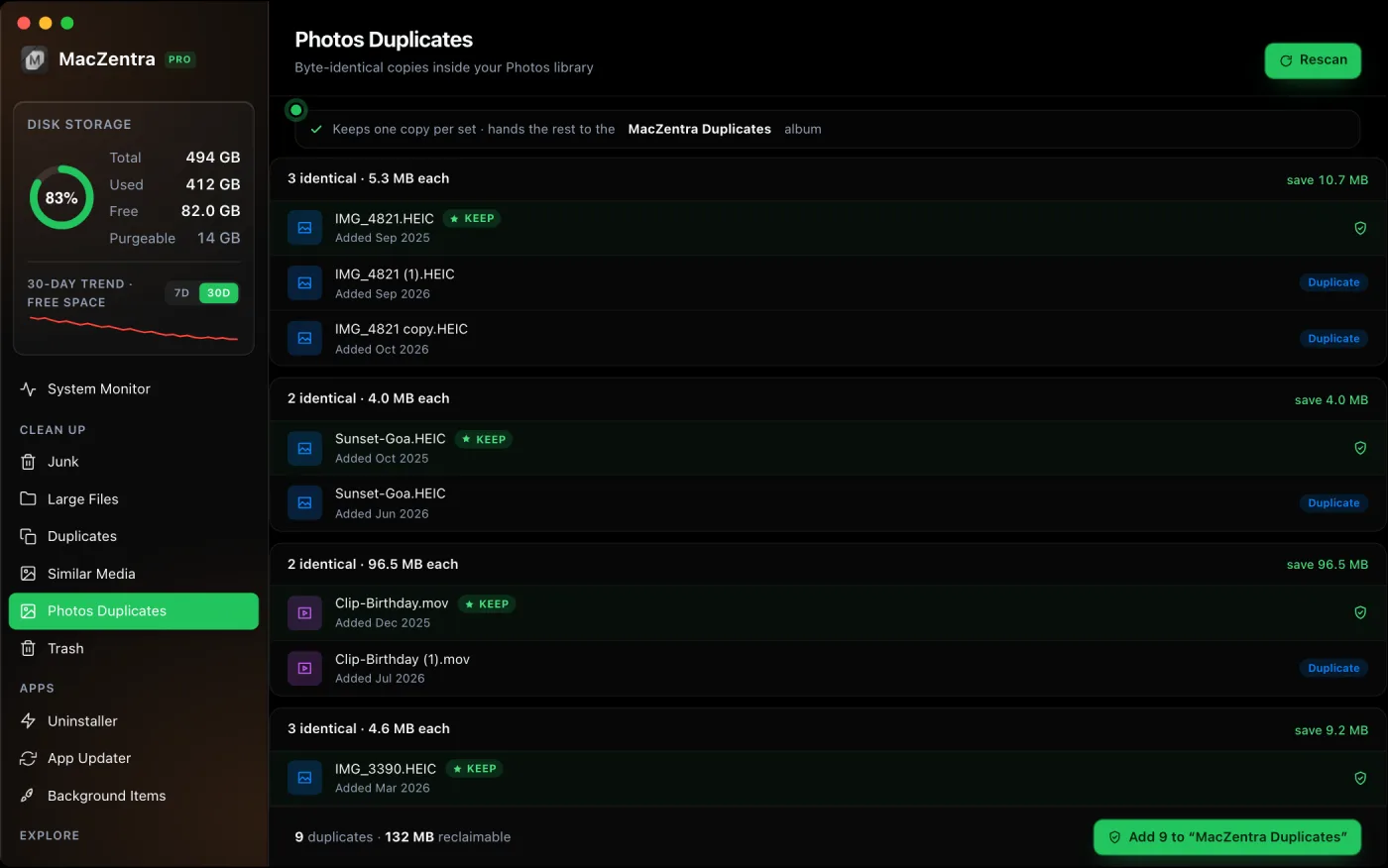
We built MacZentra with three separate tools for this job, because each one catches a different kind of copy. Photos Duplicates looks inside your Photos library for identical files, keeps one per set and puts the rest in an album called MacZentra Duplicates, so you review and delete them in Photos yourself. The Duplicate Finder checks everywhere else on the disk. Similar Media handles the resized and edited copies: it fingerprints each photo with a structural hash, a tonal hash and its aspect ratio, groups two images only when all three agree, reads HEIC and the usual formats, and never pre-selects a photo for deletion.
A sensible order to work in
- Make sure you have a recent Time Machine backup. Photo libraries are hard to rebuild.
- Work through the Duplicates album in Photos first. It's free and safe.
- Run the Smart Folder search for Downloads, Desktop and old project folders.
- Scan for near-duplicates and review each group by eye.
- Empty Recently Deleted in Photos, then empty the Trash.
- Open System Settings, General, Storage and check the new number.
Renamed and re-exported documents
The same idea applies beyond photos. A document re-exported with a tiny change, or saved as report (1).pdf, won't match by content but is essentially the same file. Fuzzy filename matching catches those by tokenizing names, dropping extensions, copy markers and bare numbers, then grouping by similarity. As with photos, these are never auto-selected, you confirm before deleting.
Questions people ask
Does deleting a photo in Photos remove it from iCloud?
Yes. With iCloud Photos on, a deletion syncs to your iPhone, iPad and iCloud. That's why the backup comes first. If you only want to free local space, Optimize Mac Storage is the safer switch, and we cover it in freeing iCloud Drive space without losing files.
Will merging duplicates lose my edits or captions?
Photos tries to keep the best version and merge the metadata. Behaviour has varied between macOS releases, so merge a small set first and check the result before you run it on the whole library.
How do I know a third-party finder is safe?
Look for three things. It should show you every match before deleting, send files to the Trash instead of erasing them, and scan on your Mac without uploading anything. If any of those is missing, skip it.
Does this work on a MacBook Air?
Yes, the steps are the same on every Mac. The Air just feels the pressure first because of its smaller drive. For the wider picture, see 10 ways to free up space on a Mac.
Everything MacZentra can clean
Treemap and Sunburst disk maps, a duplicate finder, Developer Junk, a complete app uninstaller and more, in one native storage cleaner for Mac that’s 15.4 MB.
Explore all features →Related guides
Free up space · 5 min
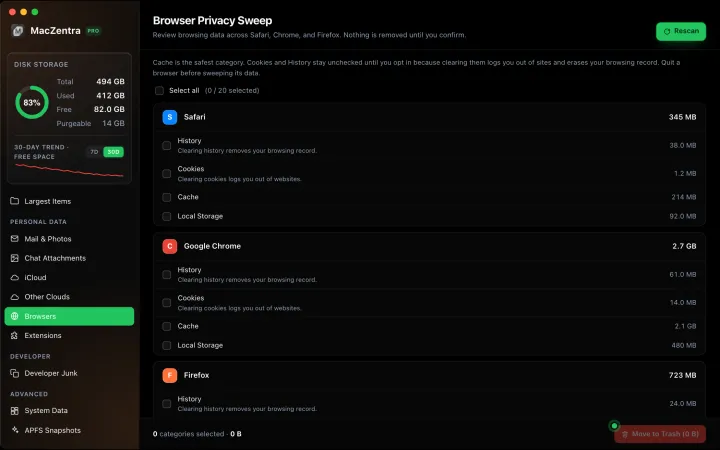
Clear Browser Cache on a Mac, Safely
Safari, Chrome and Firefox caches hold gigabytes. Where each browser stores cache, history and cookies, how much to clear, and one rule to avoid corruption.
Free up space · 6 min
Chrome Browser Cleanup on Mac: Clear the Right Data
There's no Chrome Cleanup Tool for Mac. See where Chrome keeps its cache and profile data, what's safe to clear, and the best ways to reclaim space safely.
Free up space · 9 min
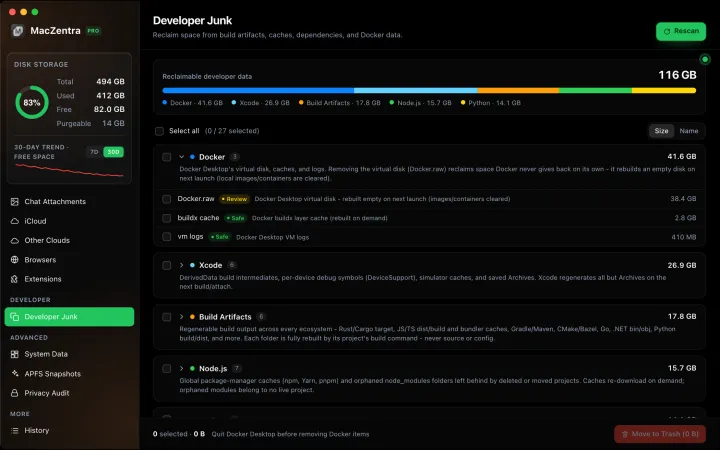
Clear Developer Caches on Mac: Homebrew, pip, Gradle
How to clear developer caches on a Mac: where Homebrew, pip, Gradle, Cargo and CocoaPods store data, the command for each, and what not to delete.
Check storage · 9 min
Best Mac Storage Cleaners 2026: Compared & Ranked
Mac storage cleaners and disk space analyzers compared by price, size, scan speed and licence. One-time, subscription and free options side by side.